The Science
Why Mangroves Are the Most Important Ecosystem You've Never Thought About
Mangrove forests sit at the intersection of land and sea, and at the center of some of the most urgent environmental challenges of our time. Here's what the science says.
The Core Problem
Nature Has a Planting Problem. We Engineered a Solution.
Mangrove restoration has been attempted for decades. The results have been deeply inconsistent, not because the science is wrong, but because the delivery mechanism has always failed.
When mangrove propagules (seeds) are planted directly on open shorelines, they face an immediate and relentless enemy: hydrodynamic energy. Tidal cycles, wave action, and storm surges physically dislodge seeds before root systems can establish. Studies consistently show that more than half of open-shore plantings fail within the first growing season.
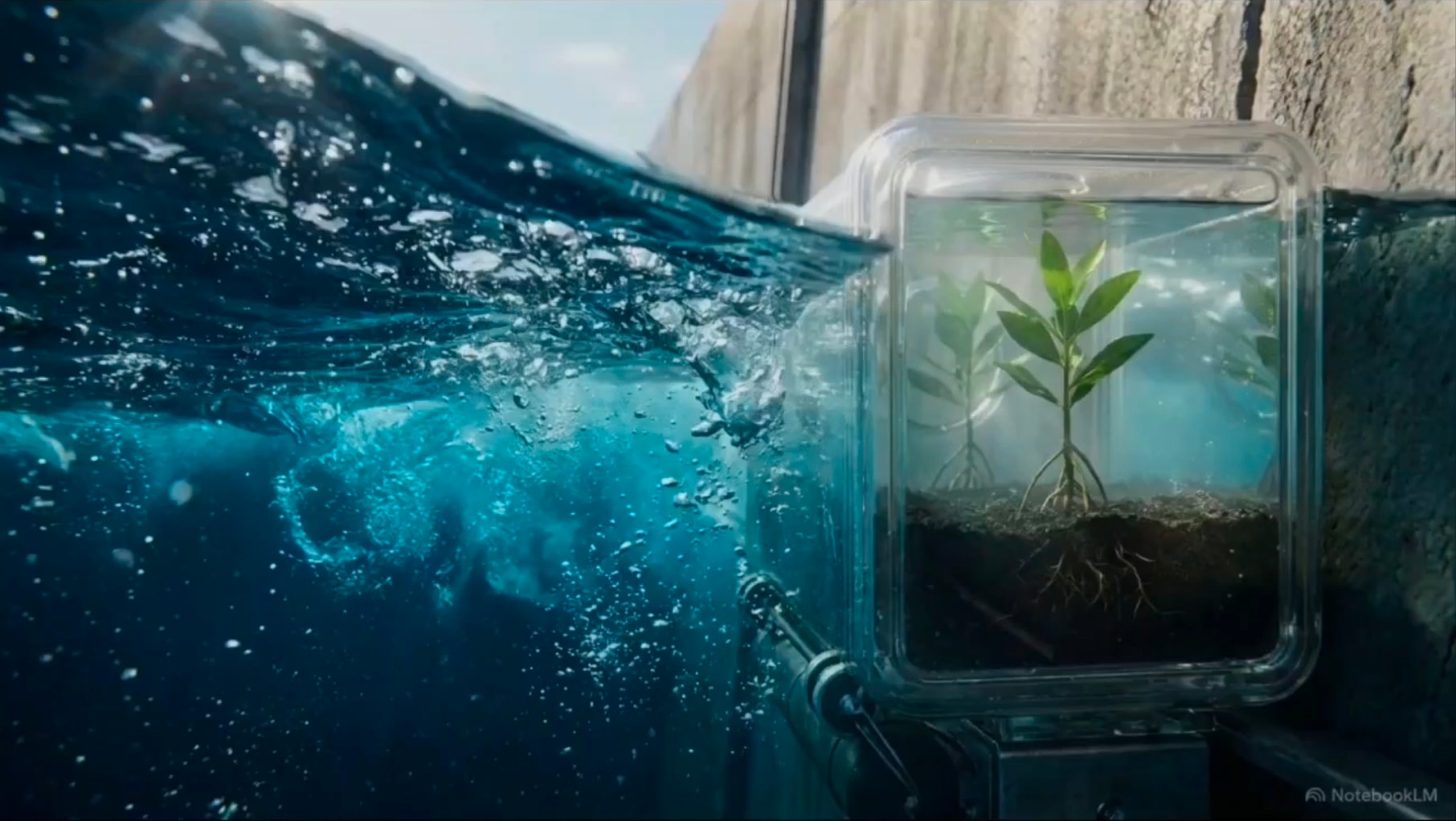
The patented Wet Soil Nursery System addresses this by removing the seed from the hostile open-shore environment during the critical establishment phase. Pods are mounted on sea walls: stable, engineered structures where propagules are held in precisely calibrated wet-soil conditions. Once root systems are established, mangroves are transferred to the shoreline.
"The ocean doesn't give seeds a second chance. The patented Wet Soil Nursery System does."
Mangrove Ecology
A Forest Built for the Edge of the World
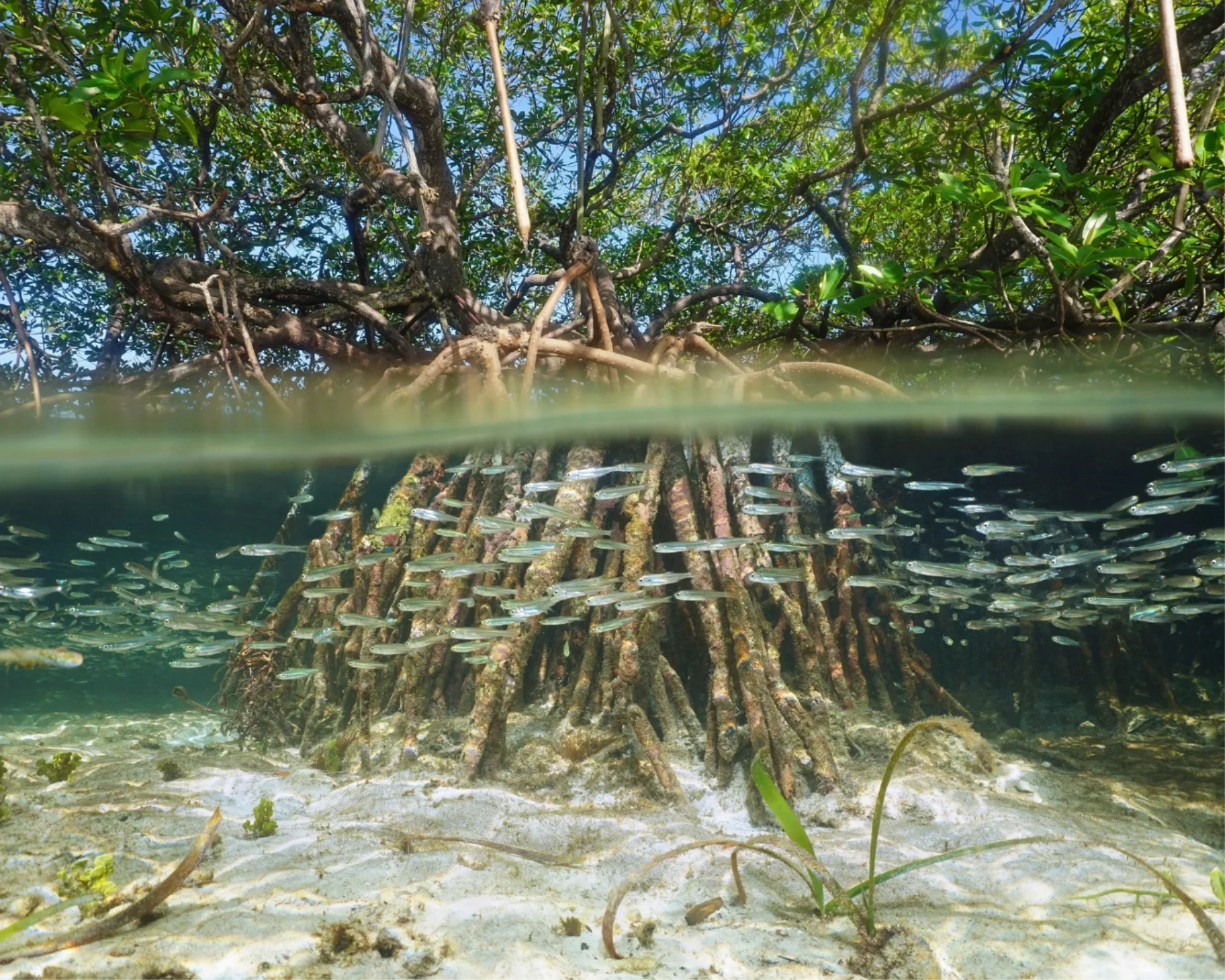
Mangroves are halophytic trees and shrubs: salt-tolerant species that thrive in the intertidal zones where freshwater rivers meet the sea. Their extraordinary root architectures (prop roots, pneumatophores, and buttress roots) allow them to anchor in unstable sediments, filter saltwater, and provide structural habitat for thousands of species. They are among the most productive and ecologically complex coastal ecosystems on Earth.
Carbon & Climate
Blue Carbon: Among the Most Studied Carbon Sinks on the Planet
Mangroves store carbon in two ways that most forests cannot: in their above-ground biomass, and in the deep, oxygen-poor sediments beneath them. This 'blue carbon' can remain sequestered for extended periods, making mangrove restoration one of the most studied climate interventions available.
Verified blue carbon credits from mangrove restoration projects are traded on international carbon markets. Pod owners through RED WHITE & BLACK's system may be eligible to participate in carbon credit programs, with verified sequestration data tied to their specific pod deployment. Details are provided during the inquiry process.
Research suggests a single hectare of mangrove forest can sequester substantially more carbon than most terrestrial ecosystems of equivalent size, though estimates vary by region and methodology.
Atmospheric Health
Oxygen Production & Atmospheric Contribution
Mangroves are among the most productive oxygen-generating coastal ecosystems on Earth. Their dense canopies and high rates of photosynthesis produce oxygen while simultaneously absorbing CO₂ and other greenhouse gases.
Healthy mangrove belts are associated with improved coastal air quality and reduced concentrations of certain pollutants in coastal environments. The relationship between coastal vegetation and broader atmospheric chemistry continues to be an active area of scientific research.
Mangrove forests produce significantly more oxygen per unit area than open ocean or terrestrial grasslands, making them disproportionately important to coastal atmospheric health.

Coastal Protection
Nature's Most Effective Coastal Buffer
The interlocking root systems of mangrove forests dissipate wave energy with significant efficiency. Research following the 2004 Indian Ocean tsunami observed that coastal communities with intact mangrove belts experienced less damage than those where mangroves had been cleared, though outcomes varied by location and forest density.
Beyond wave attenuation, mangrove roots trap sediment and build land, helping counteract coastal erosion that threatens coastal communities worldwide. As sea levels rise, this sediment-trapping function is increasingly studied as a natural coastal adaptation mechanism.
Research estimates that a 100-meter-wide mangrove belt can reduce wave height by up to 90% and storm surge by several meters, though results vary significantly by forest density, species, and local conditions.

Marine Ecosystems
The Nursery of the Sea
Mangrove root systems create a three-dimensional underwater habitat of significant complexity. The tangle of prop roots provides shelter from predators, attachment surfaces for invertebrates, and feeding grounds for juvenile fish. Studies estimate that approximately 80% of worldwide commercial fish catches depend directly or indirectly on mangrove habitats.
The ecological cascade from healthy mangroves extends beyond the forest itself. Mangroves export organic matter that feeds offshore reef systems, support migratory bird populations, and provide habitat for a range of coastal species.
Studies suggest fisheries adjacent to intact mangrove forests may produce significantly more fish per unit area than those near degraded coastlines, representing a potential economic benefit to coastal fishing communities.
The Technology
How the Patented Wet Soil Nursery System Works
Pod Mounting
Nursery pods are mounted directly onto sea walls using the patented attachment system. Sea walls provide the stable, wave-protected environment that open shores cannot.
Propagule Placement
Mangrove propagules are placed in pods in precisely calibrated wet-soil growing medium, replicating the ideal conditions for root establishment without exposure to destructive hydrodynamic forces.
Protected Growth Phase
During the critical 8–16 week establishment window, propagules develop root systems in the protected pod environment, avoiding the wave action and tidal forces that defeat open-shore planting.
Shoreline Transfer
Once established, seedlings are transferred to the shoreline with root systems developed enough to anchor against tidal and wave forces, completing the restoration cycle.

Every root system that takes hold is a coastline that holds.
The Science Is Clear. The Need Is Urgent.
Every year without action is another year of coastline lost, carbon released, and marine habitat degraded. The patented Wet Soil Nursery System exists. The question is who will deploy it.